AP U.S. GOVERNMENT & POLITICS · 2026–2027
1.1. Assignments & Activities
Unit 1: Foundations of American Democracy
Mr. Cutler · August 31–October 16, 2026 · Follow the dated schedule below
Essential question: How did the framers attempt to protect individual liberty while promoting public order and safety—and does their design still work?
October 5 schedule update: Today: Concept Application and Marbury-only SCOTUS writing practice. Tuesday, October 6: McCulloch v. Maryland, moved forward from October 8. Wednesday, October 7: no school / no regular classes for PSAT/SAT testing. The displaced extra federalism lesson and the duplicate October 8 case entry are omitted. Friday, October 9: United States v. Lopez.
How to read this page
IN CLASS: What we do together during the listed class.
HOMEWORK / PREPARATION: What to complete or prepare after class. Read the stated due date.
DUE TODAY: An assignment or assessment due on the date shown.
AP ESSENTIAL: Required AP content or skills. A “preview” label means required material from a later AP unit that we introduce early.
HELPFUL CONTEXT / CED OPTIONAL: Background or an additional source that helps explain the core material. Its CED status does not cancel an assigned class task.
AP requirements and class assignments are different. The CED is College Board’s Course and Exam Description. “CED optional” means a source is not required AP memorization. Complete every assigned class activity, reading, and quiz unless it explicitly says “Optional practice.” An enrichment reading can still have a required class assignment. Use the class review materials to determine the scope of our unit test.
What is essential, and what is extra?
| Material | AP status and study priority |
|---|---|
| Declaration; Articles of Confederation; Constitution, including the Bill of Rights; Federalist Nos. 10, 39, and 51; Brutus No. 1 | REQUIRED DOCUMENTS. Know the arguments and connect them to the constitutional principles we study. |
| Gettysburg Address | REQUIRED DOCUMENT; Topic 1.1. Connect equality and government by the people to the Declaration. A separate source lesson will address this document; it is not part of the September 28 simulation. |
| Adam Smith: core principles from The Wealth of Nations | REQUIRED; Unit 4 preview. Introduced September 17. Prioritize free enterprise, self-interest, competition, resource allocation, and limited market regulation. Detailed economic theory is enrichment. |
| Federalist No. 78 and Marbury v. Madison | REQUIRED; Unit 2 preview. We introduce the judiciary material early to connect it to constitutional checks. |
| McCulloch v. Maryland and United States v. Lopez | REQUIRED CASES; Topic 1.8. Study the facts, constitutional issue, holding, and reasoning. Practice comparing the decisions. |
| Emancipation Proclamation; 13th and 14th Amendments; incorporation | REQUIRED COURSE MATERIAL. Briefly previewed through the September 28 simulation and revisited in depth in later units. Distinguish executive wartime action, constitutional abolition, and the protection of rights against state action. |
| Locke and Hobbes readings; Federalist No. 68 | CED OPTIONAL SOURCES. Helpful for understanding required ideas. The social contract, natural rights, and Electoral College remain essential concepts. |
| Lepore’s article; Raich; Comstock | ADDITIONAL SOURCES. These are not required AP documents or cases. The assigned article quiz and case-comparison activity remain required classwork. |
| Videos, simulations, Kahoot, current examples, and textbook exercises | LEARNING AND PRACTICE TOOLS. Complete assigned work; prioritize the concepts and skills it develops. |
2026–27 update: Federalist No. 39, the Gettysburg Address, the Emancipation Proclamation, and Adam Smith’s core principles are new required additions. See College Board’s update and the current CED (printed pp. 25–30, 40–51, 68, and 102).
This is a Unit 1 schedule, not the full-year document list. Other required texts, including Federalist No. 70 and “Letter from a Birmingham Jail,” belong in later parts of the course.
Federalist readings: essential passages and AP takeaways
Use the reading buttons under the class dates below. Each button opens the assigned selections with exact start and stop words, source links, and highlighted AP GoPo: Know and Apply guidance. Read only those ranges; full papers are optional context.
Jump to the reading buttons: No. 10 · No. 51: review · No. 78 · No. 39 · No. 70: later study · No. 68: excerpt only
These are instructional selections, not an official College Board excerpt list. Required-document status means you must understand and apply the central argument. No. 70 is for later Unit 2 study, not an additional assignment this week.
Reading expectations: You remain responsible for the content we cover, even when I do not assign every textbook page. Use class notes and InQuizitive feedback to identify sections you need to revisit.
Textbook pages: Page references retain our current Election Update reading schedule. Chapter 3 is divided into pp. 88–96, 97–113, and 113–122. AP Study Guide question sets begin on pp. 36, 84, 85, and 123.
Jump to: Opening classes · September 14–18 · September 22–25 · September 28–October 2 · October 5–9 · Review and test
Opening classes · August 31–September 11
Monday, August 31 · Day 1
Welcome to AP Government
Schedule note: Special schedule: morning meeting, advisory, homeroom, and short class meetings.
IN CLASS: Introductions, syllabus review, course expectations, and an introductory Kahoot with an anonymous quiz.
EXIT TICKET / WRITTEN CHECK: What is one thing you hope to learn in this course?
HOMEWORK / PREPARATION: Read the syllabus and get your textbook. For Tuesday, September 1.
Tuesday, September 1 · Day 2
Course expectations and the purpose of government
IN CLASS: Continue introductions and review the syllabus, learning objectives, and expectations. Discuss the role of government in society.
AP ESSENTIAL: Begin connecting government’s purpose to liberty, order, and democratic principles.
HOMEWORK / PREPARATION: None — camp.
No class: September 2–3, Upper School camp at Camp JORI. Class of 2027 evening activity at Kings in Dedham on September 2. No school: September 4, extended Labor Day weekend; September 7, Labor Day.
Tuesday, September 8 · Day 3
Summer reading assessment
IN CLASS: Take the summer reading comprehension test. Afterward, begin a brief introduction to Unit 1.
HOMEWORK / PREPARATION: Due Thursday, September 10: Read Chapter 1, pp. 6–8, “Why do we have a government?” Answer AP Study Guide questions 1, 3, and 4, beginning on p. 36. Prepare to share your responses.
Thursday, September 10 · Day 4
Enlightenment foundations
IN CLASS: Review democratic ideals, then complete the FlintAI comparison activity. Compare Locke and Hobbes on the state of nature, sovereign power, and the social contract. Read selected passages from Locke, Second Treatise of Government and Hobbes, Leviathan, Part II.
AP ESSENTIAL: Topic 1.1: Natural rights, social contract, popular sovereignty, limited government, and their expression in American founding documents.
HELPFUL CONTEXT / CED OPTIONAL: Locke and Hobbes: These readings support our understanding of required ideas. Their complete works and detailed philosophical differences are not required foundational-document memorization.
EXIT TICKET / WRITTEN CHECK: How do the Declaration’s ideals still influence American politics?
HOMEWORK / PREPARATION: Homework #2 — due Friday, September 11: Read the Declaration of Independence and complete the homework portion of the FlintAI activity.
Friday, September 11 · Day 5
Declaration of Independence
IN CLASS: Continue the Declaration close reading and connect its arguments to our Enlightenment discussion. Listen to John F. Kennedy’s reading of the Declaration. Annotate the opening ideals, select five grievances you consider most serious, and identify the colonists’ proposed action in the conclusion.
IN CLASS ACTIVITY
Declaration of Independence: Close Reading
Explore natural rights, consent, popular sovereignty, and limited government through provided excerpts and explanations.
Use for close reading and review. Record your explanations in your notebook before opening the model responses. The authorship investigation is enrichment.
Opens in a new tab. No additional account or login is required.
AP ESSENTIAL: Required document: Declaration of Independence. Explain natural rights, consent, social contract, and limited government. Connect these to popular sovereignty and republicanism.
HELPFUL CONTEXT / CED OPTIONAL: The recording and Locke/Hobbes comparisons are learning tools. Focus your AP review on the document’s claims and the democratic principles it illustrates.
EXIT TICKET / WRITTEN CHECK: Explain how one idea associated with Locke appears in the Declaration.
HOMEWORK / PREPARATION: None — Rosh Hashanah no-homework weekend.
September 14–18 · Founding arguments and Adam Smith
Monday, September 14 · Day 6
Federalist No. 10 and Brutus No. 1: introduction
IN CLASS: Begin the selected Federalist No. 10 passages and the Brutus No. 1 work in class following the no-homework weekend. Bell ringer: the democracy-models infographic on p. 37, questions 7–8. Distinguish participatory, pluralist, and elite democracy. In pairs or trios, complete the Federalist No. 10 and Brutus No. 1 team challenge below. The activity supplies the passages, questions, hints, and practice points.
Read only the 5 selected passages. The guide provides exact start and stop words, source links, and highlighted AP GoPo: Know and Apply guidance.
Read Federalist No. 10: passages & AP takeaways
Opens in a new tab.
IN CLASS ACTIVITY
Federalist No. 10 & Brutus No. 1: Team Challenge
Can a large republic protect liberty? Compare the authors’ arguments using the passages provided in the activity.
About 40 minutes · Teams of 2–3. Discuss each choice, use the hints when needed, and earn practice points. Each student should keep notes on the competing arguments.
Opens in a new tab. No additional account or login is required.
AP ESSENTIAL: Topics 1.2–1.3: Both documents are required. Identify their competing arguments about representation, the size of a republic, national power, and individual liberty.
EXIT TICKET / WRITTEN CHECK: Which democratic ideal is most challenged today? Support your answer.
HOMEWORK / PREPARATION: Homework #3 — due Tuesday, September 15: Finish Federalist No. 10: selected essential passages and AP takeaways and Brutus No. 1. Bring annotations for our comparison activity.
Tuesday, September 15 · Day 7
Factions, representation, and safeguards against power
IN CLASS: Apply Madison’s argument about factions to modern groups. Compare Federalist No. 10 with Brutus No. 1. Build a chart with three columns: democracy model / evidence from either document / contemporary example. Review our already-completed work on Federalist No. 51: selected passages and AP takeaways to connect these arguments to separation of powers, checks and balances, and federalism. Use AP Study Guide questions 2–4 beginning on p. 84.
Read only the 3 selected passages. The guide provides exact start and stop words, source links, and highlighted AP GoPo: Know and Apply guidance.
Review Federalist No. 51: passages & AP takeaways
Opens in a new tab.
IN CLASS ACTIVITY
Factions, Democracy, and the Protection of Liberty
Use seven provided passages, a completed example, and sentence starters to build your democracy-models chart. Connect the comparison to our completed Federalist No. 51 work.
Pairs or trios. Each student completes a chart and the written responses in a notebook. Use the activity’s study-guide directions and exit prompt for the comparison work.
Opens in a new tab. No additional account or login is required.
AP ESSENTIAL: Topics 1.2, 1.3, and 1.6: Distinguish the large-republic solution in No. 10, the warnings in Brutus No. 1, and the institutional safeguards in No. 51. All three texts are required.
HELPFUL CONTEXT / CED OPTIONAL: Federalist No. 68: excerpt only: The p. 38 excerpt and questions 9–10 provide additional practice. No. 68 is not on the required document list; the Electoral College is required course content.
EXIT TICKET / WRITTEN CHECK: Do you agree with Madison’s solution to factions? Use evidence.
HOMEWORK / PREPARATION: For Thursday, September 17: Review your Enlightenment and Declaration notes. Prepare to connect political liberty and self-interest to Adam Smith. No new Federalist No. 51 reading.
Thursday, September 17 · Day 8
Adam Smith and economic liberty
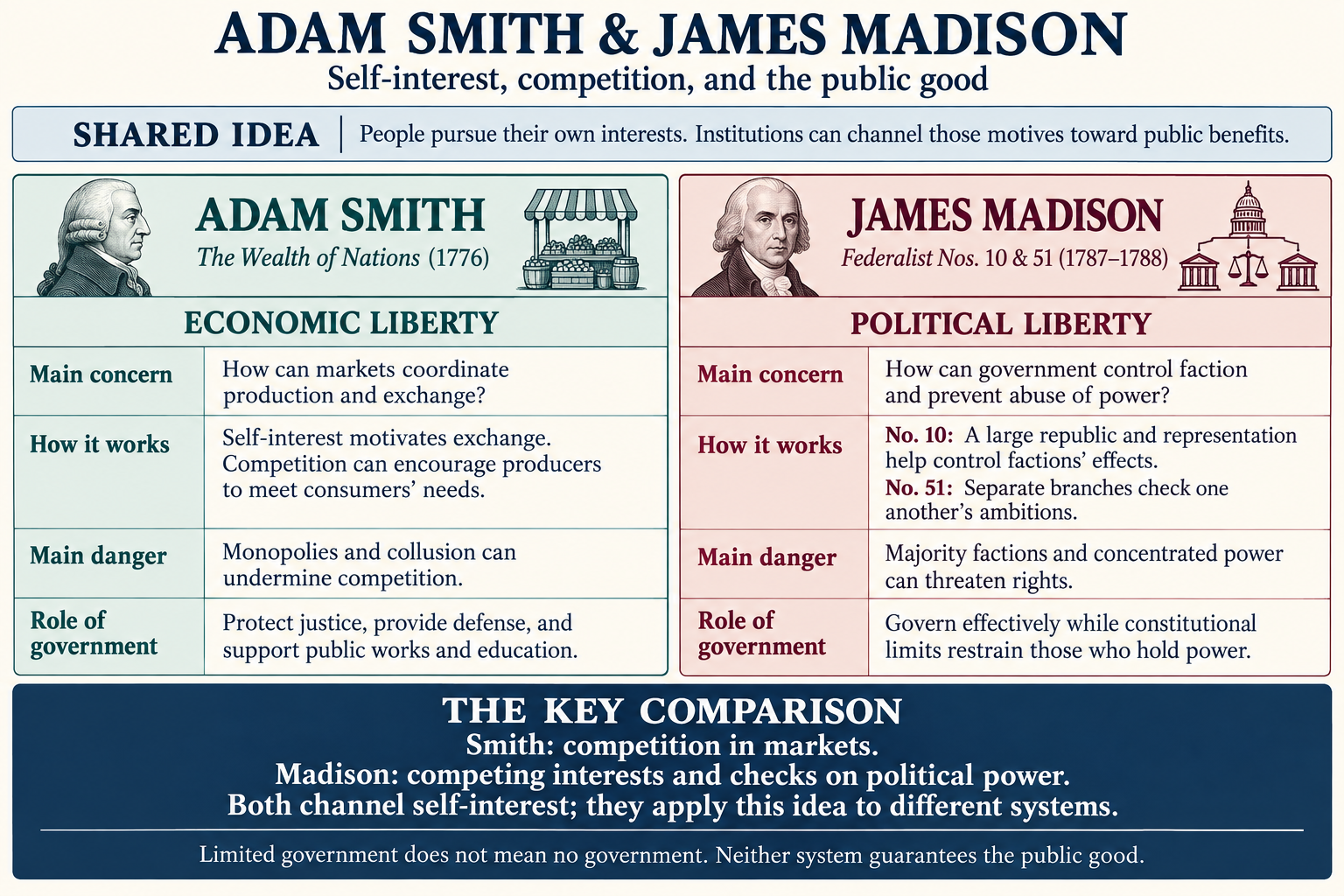
Select the comparison graphic to view it at full size.
🧠 LEARNING AND PRACTICE TOOLS. Complete assigned work; prioritize the concepts and skills it develops.
DUE TODAY: Chapter 1 InQuizitive.
IN CLASS: Introduce activity and core principles from The Wealth of Nations. Read selected excerpts together and explain self-interest, market competition, resource allocation, and limited government regulation. Use the pin-factory example to explore specialization. Compare Smith’s treatment of self-interest with Madison’s checks and balances in Federalist No. 51.
IN CLASS ACTIVITY
Adam Smith & James Madison
Explore self-interest, specialization, competition, and the role of government. Then compare Smith’s ideas with Madison’s argument in Federalist No. 51.
About 50 minutes. Keep your written responses in your notebook.
Open the Smith & Madison activity
Opens in a new tab. No additional account or login is required.
AP ESSENTIAL: Required for 2026–27 — Unit 4 preview, Topic 4.1: Know Smith’s connection to free enterprise: self-interest, competition, efficient resource allocation, and limited government regulation of markets.
HELPFUL CONTEXT / CED OPTIONAL: The pin-factory details, extended economic theory, and a detailed Smith–Locke–Madison comparison deepen understanding. Reading the entire book is not assigned. Limited government does not mean no government.
EXIT TICKET / WRITTEN CHECK: Complete the Madison & Smith practice activity. Respond before reviewing the answers and explanations.
HOMEWORK / PREPARATION: Homework #4 — due Friday, September 18: Read the Articles of Confederation.
Friday, September 18 · Day 9
Articles of Confederation
IN CLASS: Analyze the Articles’ structure and weaknesses. Discuss what happens when states retain extensive power and the national government struggles to act. Use the chart on p. 49. Connect Shays’ Rebellion, taxation and enforcement problems, the absence of a separate executive and general national judiciary, interstate commerce, and currency issues.
IN CLASS ACTIVITY
Articles of Confederation: Powers and Problems
Use the explanations, document excerpts, and practice questions to connect weaknesses in the Articles to demands for a stronger national government.
Pairs or trios. Focus on the sections assigned in class. Explain a provision, the problem it created, and a later constitutional response before opening the model answer.
Opens in a new tab. No additional account or login is required.
AP ESSENTIAL: Topic 1.4 — required document: Explain how weaknesses in the Articles helped produce demands for a stronger national government. Congress could coin money; it lacked exclusive coinage power.
EXIT TICKET / WRITTEN CHECK: Which weakness most seriously undermined the Confederation? Explain.
HOMEWORK / PREPARATION: Homework #5 — due Tuesday, September 22: Read Chapter 2, pp. 40–49, focusing on the circumstances that led to the Constitutional Convention. Keep the reading light and plan around Yom Kippur.
Monday, September 21: No class — Yom Kippur.
September 22–25 · Constitution and ratification
Tuesday, September 22 · Day 10
From the Articles to the Constitution
IN CLASS: Compare powers under the Articles and the Constitution. Connect the changes to the Federalist–Anti-Federalist debate. In pairs or trios, use pp. 50–59 to build an organizer on the Great Compromise, Electoral College, Three-Fifths Compromise, slave-importation provision, and the later ratification assurances about a Bill of Rights.
IN CLASS ACTIVITY
From the Articles to the Constitution
Compare governing powers and build an organizer on the five constitutional settlements in today’s lesson. The activity includes the Convention guide and links to the Articles evidence.
About 50 minutes · Pairs or trios · 20 practice points. Start with the directions at the top of the page. Each student keeps the organizer and ratification argument in a notebook.
Opens in a new tab. No additional account or login is required.
AP ESSENTIAL: Topics 1.4–1.5: Explain how negotiation shaped the Constitution and how proposed constitutional changes addressed weaknesses of the Articles.
EXIT TICKET / WRITTEN CHECK: Would Federalists or Anti-Federalists be more satisfied with government today? Explain.
HOMEWORK / PREPARATION: For Thursday, September 24: Continue the assigned Chapter 2 reading.
Thursday, September 24 · Day 11
Constitutional compromises and amendment process
IN CLASS: Role-play states’ interests in the Great Compromise, Three-Fifths Compromise, Electoral College, and commerce/slave-trade negotiations. Introduce Marbury v. Madison (1803) as a connection to constitutional checks. Use “Amending the Constitution,” p. 74, and Table 2.1, p. 75, to distinguish proposal from ratification.
IN CLASS ACTIVITY #1
Marbury V. Madison (1803), plus a preview of Federalist 78
Return to the Convention guide for the state-interest role-play and the amendment-process lesson.
Learn the essential components of the required SCOTUS case. Explain the important of judicial review and SCOTUS enhancing the scope of its power.
IN CLASS ACTIVITY #2
Convention Compromises & Article V
Return to the Convention guide for the state-interest role-play and the amendment-process lesson.
Use the essential-compromises and Article V sections. Explain who gained influence, what the settlement changed, and how amendment proposal differs from ratification.
Opens in a new tab. No additional account or login is required.
AP ESSENTIAL: Topic 1.5: Know the major compromises and Article V. Required Unit 2 preview: Marbury and judicial review.
HELPFUL CONTEXT / CED OPTIONAL: All adopted amendments were proposed by Congress. The Twenty-first Amendment was unusual because state conventions ratified it. See the National Archives: amendment process.
EXIT TICKET / WRITTEN CHECK: Which compromise was most essential to securing agreement? Defend your answer.
HOMEWORK / PREPARATION: Due Friday, September 25: Finish the assigned Chapter 2 reading.
Friday, September 25 · Day 12
Ratification and the Bill of Rights
Schedule note: Sukkot begins at sundown. Please plan with observing students in mind.
IN CLASS: QUIZ. Examine why opponents wanted explicit protections for individual liberty. Rank amendments and apply them to scenarios. Watch selected portions of Annenberg: “Key Constitutional Concepts”; discuss Shays’ Rebellion, checks and balances, Article V, and the original absence of a Bill of Rights. Use the Take-a-Stand activity on p. 73 for a seminar on constitutional interpretation. Alternative written practice: AP Study Guide questions 5–9 beginning on p. 85.
IN CLASS ACTIVITY
Would You Ratify?
Weigh Federalist and Anti-Federalist arguments, then test how a specific Bill of Rights protection addresses a concern about national power.
About 15 minutes · Pairs or trios · 12 practice points. Use this during the ratification discussion. Write before opening the hints and explanations.
Open the ratification activity
Opens in a new tab. No additional account or login is required.
AP ESSENTIAL: Topic 1.5; Unit 3 preview: Constitution and Bill of Rights. Connect the ratification debate to protections for individual liberty.
HELPFUL CONTEXT / CED OPTIONAL: The video and seminar format are instructional choices. Constitutional principles and the relevant rights remain essential content.
EXIT TICKET / WRITTEN CHECK: How did the Bill of Rights address Anti-Federalist concerns?
HOMEWORK / PREPARATION: Homework #7 — due Monday, September 28: Read the Bill of Rights, Amendments 1–10. Begin for Thursday, October 1: Jill Lepore, “How Originalism Killed the Constitution”. This is assigned enrichment with a required class quiz; it is not a required AP foundational document.
September 28–October 2 · Rights, courts, and federalism
Monday, September 28 · Day 13
Who protects a right? A preview of the 13th and 14th Amendments
Schedule update: Mr. Cutler will be present. We will complete a guided lesson and simulation together.
DUE TODAY: Chapter 2 InQuizitive and the previously assigned Bill of Rights reading.
IN CLASS: Begin with a Bill of Rights retrieval question: which government did its protections originally restrict? Preview the relevant provisions of the 13th and 14th Amendments with Mr. Cutler: 13th Amendment, Sections 1–2; 14th Amendment, Sections 1 and 5. Then open the simulation using the button below. Focus on constitutional mechanisms and the national–state relationship.
Who Protects a Right? · About 28 minutes. Preview the 13th and 14th Amendments through eight decisions. Distinguish the wartime proclamation from constitutional abolition; apply citizenship, due process, equal protection, and incorporation.
Open Monday’s amendments simulation
Opens in a new tab.
AP ESSENTIAL — PREVIEW: Unit 1 connections: limited government, federalism, and Article V. Unit 3 preview: civil liberties and civil rights; the 13th Amendment’s abolition of slavery; the 14th Amendment’s citizenship, Due Process, and Equal Protection Clauses; and selective incorporation. Know that most Bill of Rights protections apply to state and local governments through court decisions, generally using the 14th Amendment’s Due Process Clause. Amendments #3, #5, and #7 not incooperated—but the rest are. This developed over time; it was not automatic total incorporation in 1868.
LESSON SCOPE: Today introduces concepts that we will revisit in depth. The proclamation appears only to clarify the distinction between a wartime executive action and constitutional abolition. No full-document comparison with the Declaration is assigned today, and no new Supreme Court case memorization is required for this preview.
EXIT TICKET / WRITTEN CHECK: In 3–4 sentences, distinguish the proclamation from the 13th Amendment. Then identify one 14th Amendment protection and apply it to a state or local government action.
HOMEWORK / PREPARATION: For Tuesday, September 29: Prepare for the scheduled multiple-choice quiz using the previously announced scope. Due Thursday, October 1: Continue Jill Lepore, “How Originalism Killed the Constitution”. Be ready to identify the thesis, one supporting example, and one question or counterargument. The article quiz remains scheduled for Thursday; we will complete its simulation in class afterward.
Tuesday, September 29 · Day 14
Federalist No. 78 and constitutional checks
IN CLASS: Take the scheduled multiple-choice quiz. Read Federalist No. 78: selected essential passages and AP takeaways in class and practice AP free-response questions. In pairs, search Articles I–III of the U.S. Constitution: who declares war, taxes, creates lower federal courts, impeaches, tries impeachments, and selects judges? Cite the relevant provisions. Compare pp. 64–65 and discuss the p. 65 Critical Thinking questions.
Read only the 4 selected passages. The guide provides exact start and stop words, source links, and highlighted AP GoPo: Know and Apply guidance.
Read Federalist No. 78: passages & AP takeaways
Opens in a new tab.
IN CLASS ACTIVITY
Who Checks the Court?
Connect Federalist No. 78, judicial independence, and Marbury v. Madison. Explain how the judiciary can restrain power while remaining subject to constitutional limits.
About 15 minutes after the quiz · Pairs or trios · 12 practice points. Use this for the judiciary portion of today’s constitutional-checks practice.
Open the judicial-checks activity
Opens in a new tab. No additional account or login is required.
AP ESSENTIAL: Topic 1.6; Topic 2.8 preview: Checks and balances, judicial independence, and judicial review. Federalist No. 78 and Marbury are required AP material even though we introduce them before the judiciary unit.
EXIT TICKET / WRITTEN CHECK: Explain how impeachment functions as a check and balance.
HOMEWORK / PREPARATION: Homework #8 — due Thursday, October 1: Read Chapter 3, pp. 88–96. Finish Jill Lepore, “How Originalism Killed the Constitution” and prepare for the article quiz on Thursday.
Thursday, October 1 · Day 15
Constitutional change: amend, interpret, or legislate?
DUE TODAY: Jill Lepore, “How Originalism Killed the Constitution”; the multiple-choice article quiz; and Chapter 3, pp. 88–96. The article is a required class reading, although it is not a required AP foundational document.
IN CLASS: Take the article quiz, then open the simulation using the button below to evaluate constitutional change. Discuss three brief Lepore excerpts with questions, test Article V vote thresholds, hold an interpretation hearing, and write an individual verdict. Finish by distinguishing checks and balances among branches from federalism between national and state governments.
Amend, Interpret, or Legislate? · About 25 minutes. The activity includes three short Lepore excerpts, discussion questions, an Article V vote exercise, and an individual verdict. Support or challenge the article with evidence.
Open Thursday’s Lepore simulation & discussion
Opens in a new tab.
AP ESSENTIAL: Topics 1.5–1.7: Article V, checks and balances, and federalism. Distinguish formal changes to constitutional text from judicial interpretation and ordinary legislation. For the congressional proposal route, Article V requires two-thirds of each house and ratification by three-fourths of the states. The president has no formal approval or veto role. Connect judicial review to the Federalist No. 78 work from Tuesday.
HELPFUL CONTEXT / CED OPTIONAL: Lepore’s article: Assigned enrichment. Distinguish the author’s argument, historical evidence, and your own inference. Original public meaning can apply to new technology; considering changed circumstances does not give judges unlimited freedom to replace constitutional text. Both approaches require careful reasoning. Detailed debates among interpretive theories are enrichment.
Who Has the Power? — Part A reference
Use the existing examples to check your labels for branches, checks and balances, and levels of government during the photo activity. Use these examples for reference; October 5 is now our FRQ-writing workshop.
EXIT TICKET / WRITTEN CHECK: What is the difference between changing constitutional text and changing how existing text applies? Explain one advantage and one cost of a difficult amendment process.
HOMEWORK / PREPARATION: Homework #9 — due Friday, October 2: Read Chapter 3, pp. 97–113, focusing on changing interpretations of national and state power.
Friday, October 2 · Day 16
Federalist No. 39: national and federal features
IN CLASS: Read Federalist No. 39: selected essential passages and AP takeaways. Chart the Constitution’s national and federal features through ratification, the House, Senate, presidency, and amendment process. Connect the chart to the ratification debate and the distribution of power.
Read only the 5 selected passages. The guide provides exact start and stop words, source links, and highlighted AP GoPo: Know and Apply guidance.
Read Federalist No. 39: passages & AP takeaways
Opens in a new tab.
IN CLASS ACTIVITY
Federalist No. 39: National, Federal, or Both?
Use Madison’s definitions and supplied evidence to classify the House, Senate, presidency, ratification, amendment, and the operation of national laws.
About 15 minutes · Pairs or trios · 12 practice points. Begin with the completed House example, then build your chart and explain each classification.
Open the Federalist No. 39 activity
Opens in a new tab. No additional account or login is required.
AP ESSENTIAL: Required for 2026–27 — Topic 1.7: Explain republican government and the Constitution’s combination of national and federal features. No. 39 is an AP essential.
EXIT TICKET / WRITTEN CHECK: Is the Constitution more national or more federal? Use a specific feature to defend your answer.
HOMEWORK / PREPARATION: For Monday, October 5: Review your Federalist No. 39 chart.
October 5–9 · FRQ writing and Supreme Court cases
Monday, October 5 · FRQ Writing Practice
IN CLASS: Learn how to answer an FRQ directly. First, practice Concept Application using Unit 1 content. Then, practice a SCOTUS response using only Marbury v. Madison. Score sample answers, explain your scores, and write your own responses.
Open Today’s Activities
Work through the numbered steps below. Select “Open Today’s Activities” again to close this section.
Write a direct FRQ response
AP U.S. Government & Politics · Unit 1 + Marbury v. Madison
Start here
You will practice two kinds of FRQ writing, then act as an AP scorer. Complete the five steps below in order. Use your notebook for all work.
- Write your name, section, and date on your paper.
- Read the information and directions before answering.
- Work with a partner when scoring sample answers. Write your own responses independently.
- For each score, explain what earns credit or what is missing. A number alone is not enough.
- Open each scoring guide only after making your own judgment.
Your finished work: scores and reasons for 25 short examples, your own A–C response for each activity, scores and reasons for six complete responses, and an exit ticket.
Our rule: Answer the question as directly as possible—no more, no less. Include every required element, then stop. A short answer still needs the explanation requested. No introduction or conclusion is needed for these two FRQ types.
AP terminology: The first type is officially called Concept Application. Today’s court task is an adapted, Marbury-only preparation exercise, not a complete AP SCOTUS Comparison question. No other Supreme Court case is required today.
On the actual AP exam: You have 100 minutes total for all four free-response questions. College Board suggests about 20 minutes for Concept Application and about 20 minutes for SCOTUS Comparison. These are pacing recommendations, not separate enforced time limits. You manage your time across the section.
Step 1 · Learn what earns a point
Read this information first. It explains the task verbs and the scoring rules you will use in the activities.
| Task verb | What is expected | Useful starting structure |
|---|---|---|
| Identify | Name the requested concept, clause, or power accurately. A precise phrase can be enough. | “The power is ___.” |
| Describe | Give the relevant characteristics or actions. A vocabulary label alone is not enough. | “___ does ___.” |
| Explain | State how or why: connect a specific fact or rule to a result. Do not leave the connection for the reader to infer. | “Because ___, ___.” |
| Compare | When asked, address both cases and explain the relevant similarity or difference. | “In one case ___; in the other ___; this explains ___.” |
- Read all parts first. Circle each task verb and note what it asks about.
- Find the relevant fact. Use the scenario or the case; ignore unrelated background.
- Label your answers A, B, and C. Give a direct answer, then the required description or explanation.
- Check your work against each target. Usually one or two focused sentences are enough; a two-point part may need more. There is no required sentence count.
- Stop when the task is complete. Do not add a second guess or a mini-essay.
How points work
| Task | Point structure | What that means today |
|---|---|---|
| Concept Application | A: 1 · B: 1 · C: 1 = 3 | Each part earns its point by meeting the target. No half-points. |
| Full AP SCOTUS Comparison | A: 1 · B: up to 2 · C: 1 = 4 | A typical Part B earns partial credit for relevant required-case information; full credit needs the prompted comparison and explanation. Read the particular rubric. |
| Today’s Marbury-only preparation | A: 1 · B: 2 · C: 1 = 4 practice points | Our Part B uses two stated classroom criteria. It does not test a second case. This is a practice score, not an AP score of 1–5. |
“Good,” “great,” and “excellent” are writing descriptions—not AP scoring levels. Each part includes three successful examples and an answer that earns no credit. The two-point Marbury part also includes a partial-credit example. A good answer can already earn full credit. Greater precision may make an answer clearer, but it does not create bonus points. Decide which version completes the task most efficiently.
What does not cost a separate point: no hook, introduction, conclusion, fancy vocabulary, quotation, or formal citation; a short response that fully answers the prompt; spelling or grammar slips that do not obscure meaning. These are content-and-reasoning rubrics, not style rubrics. A case date or justice’s name is not needed unless the prompt calls for it.
What can prevent credit: an incorrect concept, a missing required element, an unexplained connection, or a contradiction that makes the answer inaccurate. You earn points for meeting criteria; you do not start with full credit and lose a point for every error. A missed part does not automatically erase credit in other parts, but a repeated error can affect each part that depends on it. Extra writing earns nothing by itself.
Step 2 · Concept Application
Your instructions
- Read the scenario and information below. Use only the Article V and federalism ideas explained here.
- Read Part A, then B, then C. Each part tells you what to do and what earns its point.
- Score every sample response. Give each answer 0 or 1. Write a brief reason beside each score. Underline the words that earn credit, or name what is wrong or missing.
- Open the Activity 1 scoring guide after scoring all three parts. Compare your reasoning with the explanations. Correct any score you would change.
- Write your own complete A–C response. Use the same scenario and questions. Cover the examples, write in your own words, and self-score out of 3.
Original practice scenario: Members of Congress propose a constitutional amendment. Two-thirds of the House and two-thirds of the Senate approve the proposal. The legislatures of 38 states then ratify it. The president opposes the amendment and announces an intention to veto it.
Information you need: Article V provides a formal amendment process. Federalism divides authority between national and state governments. In this congressional proposal route, two-thirds of each house propose and three-fourths of the states ratify. In a union of 50 states, three-fourths means at least 38. The president has no formal approval or veto role.
Part A · 1 point
Question: Describe the constitutional amendment process used in the scenario.
What to do: Name the process and describe both stages shown: congressional proposal and state ratification. Include the thresholds. A label alone does not satisfy “describe.”
What earns credit: 1 point: accurately describes proposal by two-thirds of each house of Congress and ratification by three-fourths of the states. 0 points: omits a stage or gives an incorrect threshold.
| Response | Student answer | Your score & reason |
|---|---|---|
| Response 1 | Article V requires two-thirds of each house to propose this amendment and three-fourths of the states to ratify it; 38 states therefore complete ratification. | ___ / 1 Why? __________ |
| Response 2 | Two-thirds of each house of Congress propose the amendment, and three-fourths of the states ratify it. | ___ / 1 Why? __________ |
| Response 3 | Under Article V, a two-thirds vote in each house proposes the amendment; ratification by three-fourths of the states makes it part of the Constitution. | ___ / 1 Why? __________ |
| Response 4 | They amend the Constitution. | ___ / 1 Why? __________ |
Part B · 1 point
Question: Explain how the states’ role in this scenario illustrates federalism.
What to do: Connect federalism to the division of authority between national and state governments. Explain why Congress cannot complete this process on its own.
What earns credit: 1 point: connects the national proposal role and the states’ necessary ratification role to a division of authority between levels of government. 0 points: only defines federalism or confuses levels with branches.
| Response | Student answer | Your score & reason |
|---|---|---|
| Response 1 | Congress proposes the amendment, but it cannot adopt it without state ratification. This divides amendment authority between the national and state levels. | ___ / 1 Why? __________ |
| Response 2 | Federalism divides authority between national and state governments, so Congress can propose the amendment but needs the states to ratify it. | ___ / 1 Why? __________ |
| Response 3 | Requiring 38 states to ratify means Congress cannot change the Constitution alone, illustrating federalism’s division of authority between national and state governments. | ___ / 1 Why? __________ |
| Response 4 | Federalism divides power among the president, Congress, and the courts. | ___ / 1 Why? __________ |
Part C · 1 point
Question: Explain why the president cannot prevent this amendment’s adoption by vetoing it.
What to do: State the constitutional reason and apply it to the threatened veto. Do not treat an amendment proposal as an ordinary bill.
What earns credit: 1 point: explains that Article V gives the president no formal approval or veto role, so the stated proposal-and-ratification process can proceed despite presidential opposition. 0 points: merely says the veto fails or uses ordinary-bill override rules.
| Response | Student answer | Your score & reason |
|---|---|---|
| Response 1 | Because Article V assigns adoption to proposal and state ratification without a presidential veto, the president cannot block this amendment after the required votes. | ___ / 1 Why? __________ |
| Response 2 | The president has no veto role in Article V, so presidential opposition cannot stop this amendment from being adopted. | ___ / 1 Why? __________ |
| Response 3 | Article V does not require presidential approval of amendment proposals. The amendment can therefore be adopted through congressional proposal and state ratification despite the threatened veto. | ___ / 1 Why? __________ |
| Response 4 | Congress overrides the amendment veto with two-thirds of both houses. | ___ / 1 Why? __________ |
Activity 1 scoring guide — open after scoring
Open this only after you have scored the examples and explained why. Good, great, and excellent describe the writing; they do not create extra AP points.
Concept · Part A
| Writing example | Score | Why it earns credit |
|---|---|---|
| Response 1: Excellent | 1/1 | Connects the rule directly to the scenario’s 38 states. The extra precision earns no extra point. |
| Response 2: Good | 1/1 | Both stages and thresholds appear. This is enough. |
| Response 3: Great | 1/1 | Names Article V and distinguishes proposal from final adoption. |
| Response 4: No credit | 0/1 | Names the process but does not describe the proposal and ratification stages required by this classroom rubric. How to fix it: Add the two-thirds vote in each house of Congress and ratification by three-fourths of the states. |
Concept · Part B
| Writing example | Score | Why it earns credit |
|---|---|---|
| Response 1: Great | 1/1 | Makes the consequence of divided authority explicit. |
| Response 2: Good | 1/1 | Defines the relevant relationship and applies it to the process. |
| Response 3: Excellent | 1/1 | Uses the scenario to explain the mechanism in one direct sentence. |
| Response 4: No credit | 0/1 | Confuses separation of powers among branches with federalism between national and state governments. It does not explain the states’ role. How to fix it: Explain that Congress proposes but state ratification is necessary, dividing authority between levels of government. |
Concept · Part C
| Writing example | Score | Why it earns credit |
|---|---|---|
| Response 1: Excellent | 1/1 | States the constitutional reason and applies it without retelling the scenario. |
| Response 2: Good | 1/1 | Gives the rule and its consequence. |
| Response 3: Great | 1/1 | Connects the absence of a presidential role to the actual process. |
| Response 4: No credit | 0/1 | Incorrectly treats a proposed amendment as an ordinary bill. There is no presidential veto to override in the Article V process. How to fix it: State that Article V gives the president no formal approval or veto role, so the amendment can proceed despite presidential opposition. |
Independent writing: Look back only at the scenario, questions, and scoring targets. Write your own A, B, and C without copying an example. Self-score each part 0 or 1 and total your score out of 3. Underline the words that earn each point.
Step 3 · Marbury / SCOTUS
Your instructions
- Read the Marbury information below. Separate what happened, what the Court decided, and why.
- Read Parts A, B, and C. A and C are worth 1 point each. B has two required tasks and is worth 2 points.
- Score every sample response. Use 0 or 1 for A and C; use 0, 1, or 2 for B. Explain every score, including why a partially correct answer does not earn full credit.
- Open the Activity 2 scoring guide after scoring all three parts. Read why each answer earns or misses credit.
- Write your own complete A–C response. Cover the examples and use the same questions. Self-score out of 4 using the classroom rubric.
SCOTUS means Supreme Court of the United States. On the full AP comparison question, you connect a required case you know to a nonrequired case summarized in the prompt. That supplied summary gives you the second case’s necessary information. Today we practice identifying, describing, and explaining with Marbury alone; a later lesson will add a genuine case comparison.
Marbury v. Madison (1803): the facts you need
| Element | Essential information |
|---|---|
| Facts | William Marbury’s signed commission was not delivered. He asked the Supreme Court to order Secretary of State James Madison to deliver it. The requested court order was a writ of mandamus. |
| Constitutional issue | Could Congress authorize the Supreme Court to hear this request in its original jurisdiction beyond the categories Article III allows? Original jurisdiction means hearing a case first, rather than reviewing a lower court’s decision. |
| Holding and reasoning | The Court concluded that the statutory grant exceeded Article III. Congress could not enlarge the Court’s constitutionally specified original jurisdiction by ordinary legislation. The Court invalidated the conflicting provision and could not issue the requested order in this case. |
| Significance | Marbury established judicial review of federal laws: the Court can declare a law unconstitutional. This checks Congress and reinforces limited government. The Court did not order Madison to deliver the commission. |
Step by step: the SCOTUS skill
- Separate fact, holding, and reasoning. Fact: what happened. Holding: what the Court decided. Reasoning: why the Constitution led to that result.
- For A, identify precisely. Use the requested doctrine, clause, or principle.
- For B, connect facts to the constitutional reason and result. Today, answer both parts of the Marbury prompt. In a full comparison, explain how relevant facts in both cases account for similar or different holdings.
- For C, explain the requested political connection. Today, show how the Court checked Congress. Merely saying “checks and balances” is not an explanation.
- Check and stop. A case biography or every fact you remember will not substitute for the requested connection.
Part A · 1 point
Question: Identify the judicial power established by Marbury v. Madison.
What to do: Give the precise name. “Identify” does not require a case narrative.
What earns credit: 1 point: identifies judicial review. 0 points: identifies another power or only says the Court gained power.
| Response | Student answer | Your score & reason |
|---|---|---|
| Response 1 | Marbury established judicial review: courts can declare laws unconstitutional. | ___ / 1 Why? __________ |
| Response 2 | Judicial review. | ___ / 1 Why? __________ |
| Response 3 | Marbury established judicial review. | ___ / 1 Why? __________ |
| Response 4 | Judicial power. | ___ / 1 Why? __________ |
Part B · 2 points
Question: Describe what Marbury asked the Supreme Court to do, and explain why the Court could not grant his request in this case.
What to do: First, describe the requested order to Madison. Second, explain the Article III jurisdiction problem and its consequence. Connect the law’s attempted expansion of original jurisdiction to the Court’s refusal to issue the order.
What earns credit: Classroom rubric, 2 points: 1 point for describing Marbury’s request for an order requiring Madison to deliver his commission; 1 point for explaining that the statutory grant of original jurisdiction exceeded Article III, so the Court invalidated that provision and could not issue the order in this case. These two classroom criteria are scored separately.
| Response | Student answer | Your score & reason |
|---|---|---|
| Response 1 | Marbury sought a writ of mandamus ordering Madison to deliver his commission. Because Congress could not expand the Court’s original jurisdiction beyond Article III, the Court invalidated that part of the Judiciary Act and denied the request. | ___ / 2 Why? __________ |
| Response 2 | Marbury wanted the Court to order Madison to deliver his commission. The law giving the Court original jurisdiction over that request went beyond Article III, so the Court struck down that provision and could not issue the order. | ___ / 2 Why? __________ |
| Response 3 | Marbury sought an order compelling delivery of his commission. The Judiciary Act’s attempted expansion of original jurisdiction conflicted with Article III, so the Court invalidated that provision and lacked jurisdiction to grant his request. | ___ / 2 Why? __________ |
| Response 4 | Marbury asked the Supreme Court to remove Madison from office. The Court refused because the president controlled the Court. | ___ / 2 Why? __________ |
| Response 5 | Marbury asked the Court to make Madison deliver his commission. The Court established judicial review. | ___ / 2 Why? __________ |
Part C · 1 point
Question: Explain how Marbury v. Madison illustrates checks and balances between the judicial and legislative branches.
What to do: Name the judicial action, name the branch it restrains, and explain how the action limits that branch. Use Marbury rather than a different case.
What earns credit: 1 point: explains that the Court invalidated an unconstitutional provision of a law enacted by Congress, checking legislative power against constitutional limits. 0 points: only names judicial review or says the Court became powerful.
| Response | Student answer | Your score & reason |
|---|---|---|
| Response 1 | The Court’s refusal to apply Congress’s unconstitutional expansion of original jurisdiction checked legislative power by enforcing Article III’s limits. | ___ / 1 Why? __________ |
| Response 2 | The Court checked Congress by striking down a law provision that violated the Constitution. | ___ / 1 Why? __________ |
| Response 3 | By invalidating the Judiciary Act provision that exceeded Article III, the Court limited Congress’s ability to expand judicial power through legislation. | ___ / 1 Why? __________ |
| Response 4 | The Court became more powerful. | ___ / 1 Why? __________ |
Activity 2 scoring guide — open after scoring
Open this only after you have scored the examples and explained why. Good, great, and excellent describe the writing; they do not create extra AP points.
Marbury · Part A
| Writing example | Score | Why it earns credit |
|---|---|---|
| Response 1: Excellent | 1/1 | Adds an accurate definition, but the first two answers already earn the point. |
| Response 2: Good | 1/1 | The correct identification fully answers this prompt. |
| Response 3: Great | 1/1 | A clear complete sentence; no extra credit for its length. |
| Response 4: No credit | 0/1 | Too broad. The response does not identify the specific power established by Marbury. How to fix it: Name judicial review. |
Marbury · Part B
| Writing example | Score | Why it earns credit |
|---|---|---|
| Response 1: Great | 2/2 | Uses the legal term accurately and links the jurisdiction limit to the holding. |
| Response 2: Good | 2/2 | Supplies the requested action and a constitutional explanation for the result. |
| Response 3: Excellent | 2/2 | Explains the conflict and its consequence precisely. Naming “writ of mandamus” is not necessary here. |
| Response 4: No credit | 0/2 | Neither criterion is met: Marbury sought delivery of his commission, not Madison’s removal, and the Court’s refusal rested on Article III jurisdiction, not presidential control. How to fix it: Describe the requested order to deliver the commission, then explain that Congress’s attempted expansion of original jurisdiction conflicted with Article III. |
| Response 5: Partial credit | 1/2 | The first sentence earns the requested-action point. The second names a doctrine but does not explain why the Court lacked jurisdiction to grant this request. How to fix it: Add that the statutory expansion of original jurisdiction exceeded Article III, so the Court invalidated that provision and could not issue the order. |
Marbury · Part C
| Writing example | Score | Why it earns credit |
|---|---|---|
| Response 1: Excellent | 1/1 | Explains the mechanism in one focused sentence; additional background would not add credit. |
| Response 2: Good | 1/1 | Names the checking action, its target, and its constitutional basis. |
| Response 3: Great | 1/1 | Uses the specific constitutional conflict to explain the check. |
| Response 4: No credit | 0/1 | Does not explain a check on Congress: it names neither the unconstitutional provision nor the judicial action that limited legislative power. How to fix it: Explain that the Court invalidated a congressional law provision that exceeded constitutional limits. |
Independent writing: Cover the examples. Write your own Marbury A, B, and C. Score A out of 1, B out of 2, and C out of 1. Mark which words satisfy each requirement. Keep the response as short as it can be while still completing the task.
Step 4 · Put on Your Judge’s Hat
You are now the scorer. Below are three complete Concept Application responses and three complete Marbury responses to the same prompts you practiced. Some are strong, some earn partial credit, and some earn no credit. Decide using the rubric—not length, confidence, or fancy wording.
- Score independently first. Give a score for A, B, and C, then add the total. Do not give half-points.
- Defend every score. Quote or underline the exact words that earn credit. For a missed point, identify the incorrect idea or missing explanation.
- Compare with a partner. If your scores differ, use the scoring criteria to resolve the disagreement.
- Recommend a revision. Name the smallest change needed to earn the missing point. Do not demand more writing from an answer that is already complete.
- Check the guide after judging all six responses. Explain any score you changed.
Concept Application prompt · 3 points
Scenario: Two-thirds of each house of Congress approve a proposed constitutional amendment. The legislatures of 38 states ratify it. The president opposes the amendment and threatens to veto it.
A. Describe the constitutional amendment process used in the scenario.
B. Explain how the states’ role in this scenario illustrates federalism.
C. Explain why the president cannot prevent this amendment’s adoption by vetoing it.
Judge the Concept Application responses
Complete response 1
A. Two-thirds of the House and Senate propose the amendment, and three-fourths of the states ratify it.
B. Federalism means that national and state governments share power.
C. Article V gives the president no formal veto role, so the president cannot stop adoption through the required proposal and ratification process.
| Part | Your score | Your evidence and reasoning |
|---|---|---|
| A | ___ / 1 | Which words earn credit? What is missing or incorrect? |
| B | ___ / 1 | Which words earn credit? What is missing or incorrect? |
| C | ___ / 1 | Which words earn credit? What is missing or incorrect? |
Total: ___ / 3. Explain why this total follows from the rubric. What is the smallest change that would improve this response? If it already earns full credit, explain why additional writing is unnecessary.
Complete response 2
A. A simple majority in both houses passes the amendment, and the president signs it into the Constitution.
B. Federalism works because Congress makes laws, the president enforces them, and the Supreme Court interprets them.
C. The president can veto the amendment, but Congress can override the veto with a two-thirds vote.
| Part | Your score | Your evidence and reasoning |
|---|---|---|
| A | ___ / 1 | Which words earn credit? What is missing or incorrect? |
| B | ___ / 1 | Which words earn credit? What is missing or incorrect? |
| C | ___ / 1 | Which words earn credit? What is missing or incorrect? |
Total: ___ / 3. Explain why this total follows from the rubric. What is the smallest change that would improve this response? If it already earns full credit, explain why additional writing is unnecessary.
Complete response 3
A. Under Article V, two-thirds of each house of Congress propose the amendment, and three-fourths of the states ratify it; 38 states meet that requirement.
B. Congress cannot change the Constitution without state ratification. This divides amendment authority between national and state governments, illustrating federalism.
C. Because Article V gives the president no formal approval or veto role, the president’s opposition cannot prevent adoption after the required proposal and ratification votes.
| Part | Your score | Your evidence and reasoning |
|---|---|---|
| A | ___ / 1 | Which words earn credit? What is missing or incorrect? |
| B | ___ / 1 | Which words earn credit? What is missing or incorrect? |
| C | ___ / 1 | Which words earn credit? What is missing or incorrect? |
Total: ___ / 3. Explain why this total follows from the rubric. What is the smallest change that would improve this response? If it already earns full credit, explain why additional writing is unnecessary.
Marbury-only SCOTUS preparation prompt · 4 practice points
A. Identify the judicial power established by Marbury v. Madison.
B. Describe what Marbury asked the Supreme Court to do, and explain why the Court could not grant his request in this case.
C. Explain how Marbury v. Madison illustrates checks and balances between the judicial and legislative branches.
Use the same classroom rubric: A = 1, B = 2, C = 1. This remains a Marbury-only preparation task, not a full two-case AP comparison.
Judge the Marbury responses
Complete response 1
A. Judicial review.
B. Marbury asked the Court to order Madison to deliver his commission. The Court could not help because Madison did not want to cooperate.
C. The decision shows checks and balances because the Court told the president what to do.
| Part | Your score | Your evidence and reasoning |
|---|---|---|
| A | ___ / 1 | Which words earn credit? What is missing or incorrect? |
| B | ___ / 2 | Which words earn credit? What is missing or incorrect? |
| C | ___ / 1 | Which words earn credit? What is missing or incorrect? |
Total: ___ / 4. Explain why this total follows from the rubric. What is the smallest change that would improve this response? If it already earns full credit, explain why additional writing is unnecessary.
Complete response 2
A. Marbury established judicial review.
B. Marbury sought a court order requiring Madison to deliver his commission. Congress’s statutory expansion of the Court’s original jurisdiction conflicted with Article III, so the Court invalidated that provision and lacked jurisdiction to issue the order.
C. By invalidating a law provision that exceeded Article III, the Court checked Congress and enforced constitutional limits on legislative power.
| Part | Your score | Your evidence and reasoning |
|---|---|---|
| A | ___ / 1 | Which words earn credit? What is missing or incorrect? |
| B | ___ / 2 | Which words earn credit? What is missing or incorrect? |
| C | ___ / 1 | Which words earn credit? What is missing or incorrect? |
Total: ___ / 4. Explain why this total follows from the rubric. What is the smallest change that would improve this response? If it already earns full credit, explain why additional writing is unnecessary.
Complete response 3
A. The power to make federal laws.
B. Marbury asked the Court to fire Madison. The Court granted his request because judges outrank executive officials.
C. Checks and balances means the Court may replace any law whenever the justices dislike it.
| Part | Your score | Your evidence and reasoning |
|---|---|---|
| A | ___ / 1 | Which words earn credit? What is missing or incorrect? |
| B | ___ / 2 | Which words earn credit? What is missing or incorrect? |
| C | ___ / 1 | Which words earn credit? What is missing or incorrect? |
Total: ___ / 4. Explain why this total follows from the rubric. What is the smallest change that would improve this response? If it already earns full credit, explain why additional writing is unnecessary.
Judges’ scoring guide — open after scoring all six responses
These scores apply to the classroom rubrics given above. An answer can sound confident and still earn zero. A short answer can earn full credit.
Concept Application · scoring guide
Complete response 1: 2/3
| Part | Score | Scoring reasoning |
|---|---|---|
| A | 1/1 | Describes both stages with the correct thresholds. |
| B | 0/1 | Provides a general definition but never explains how the states’ ratification role in this scenario divides amendment authority. |
| C | 1/1 | Connects the absence of a presidential veto role to the amendment’s adoption. |
Revision verdict: For B, add that Congress cannot adopt the amendment without state ratification.
Complete response 2: 0/3
| Part | Score | Scoring reasoning |
|---|---|---|
| A | 0/1 | Uses the ordinary legislative process, gives the wrong proposal threshold, and omits state ratification. |
| B | 0/1 | Describes separation of powers among branches, not federalism between levels of government. |
| C | 0/1 | Incorrectly assumes that the president can veto an amendment proposal. |
Revision verdict: Rebuild the response around Article V: congressional proposal, state ratification, and no presidential veto.
Complete response 3: 3/3
| Part | Score | Scoring reasoning |
|---|---|---|
| A | 1/1 | Accurately describes the stages, thresholds, and 38-state application. |
| B | 1/1 | Explains how required state participation prevents unilateral national action. |
| C | 1/1 | Gives the constitutional reason and applies it to the threatened veto. |
Revision verdict: No additional content is necessary. The response already meets every target.
Marbury · scoring guide
Complete response 1: 2/4
| Part | Score | Scoring reasoning |
|---|---|---|
| A | 1/1 | Correctly identifies judicial review. |
| B | 1/2 | The request for delivery earns one point. Madison’s unwillingness does not explain the Article III jurisdictional barrier, so the second point is not earned. |
| C | 0/1 | Does not explain the judicial check on Congress asked for in the prompt; the Court did not order the commission delivered. |
Revision verdict: Replace the second sentence of B with the Article III jurisdiction explanation. In C, explain the Court’s invalidation of an unconstitutional congressional law provision.
Complete response 2: 4/4
| Part | Score | Scoring reasoning |
|---|---|---|
| A | 1/1 | Identifies the requested doctrine. |
| B | 2/2 | Describes the requested order and explains the constitutional conflict that prevented the Court from issuing it. |
| C | 1/1 | Explains a specific judicial action and how it restrained Congress. |
Revision verdict: No further detail is needed. The response is accurate, direct, and complete.
Complete response 3: 0/4
| Part | Score | Scoring reasoning |
|---|---|---|
| A | 0/1 | Mistakes legislative power for judicial review. |
| B | 0/2 | Misstates both the requested action and the result; it supplies no accurate jurisdictional explanation. |
| C | 0/1 | Judicial review rests on constitutional limits, not a general power to replace laws based on policy preferences. |
Revision verdict: Identify judicial review, correct the commission and jurisdiction facts, and explain the constitutional check on Congress.
Step 5 · Exit ticket
- Revise one answer to add a missing connection or remove unnecessary wording.
- Explain: Why can a “good” answer earn exactly the same score as an “excellent” answer?
- Complete: “When a prompt says explain, I need to ___.”
Before you finish: Your paper should include your name, section, date, scores and brief reasons for all 25 examples, your two original A–C responses, your scores and reasons for the six complete responses, and the exit ticket. Practice totals are 3 and 4; they do not automatically determine a classroom grade.
Sources and scope
Exam timing follows College Board’s released exam directions. The point structures and full exam formats follow College Board’s fall 2026 Course and Exam Description, printed pp. 183 and 187–188 and released scoring guidelines, Questions 1 and 3. The prompts, samples, quality labels, and Marbury-only rubric above are instructional adaptations. Content references: National Archives: amendment process; Constitution Annotated: Marbury and judicial review.
HOMEWORK: No new written assignment. Bring today’s work and your notes for Tuesday’s McCulloch v. Maryland lesson.
Tuesday, October 6 · Day 18
McCulloch v. Maryland
IN CLASS: Analyze McCulloch v. Maryland (1819), the Necessary and Proper Clause, and federal supremacy. Use “How a Case Gets to the U.S. Supreme Court” as support. Build paired-case comparisons: McCulloch with United States v. Comstock (2010), and Lopez with Gonzales v. Raich (2005). Compare facts, constitutional issues, holdings, and reasoning.
IN CLASS ACTIVITY
Where Does National Power End? — McCulloch
Use the supplied facts, constitutional questions, holding, and reasoning to brief McCulloch v. Maryland and prepare a comparison with Lopez.
About 15 minutes · Pairs or trios. Complete the McCulloch section today. Begin with this case before the later comparison work. The full two-day activity offers 16 practice points.
Opens in a new tab. No additional account or login is required.
AP ESSENTIAL: Topic 1.8 — required case: McCulloch. Explain implied powers, federal supremacy, and how the Court’s reasoning affected national authority.
HELPFUL CONTEXT / CED OPTIONAL: Raich and Comstock are companion cases, not required AP cases. Complete the comparison activity. For AP review, prioritize McCulloch and Lopez and the skill of comparing cases.
EXIT TICKET / WRITTEN CHECK: How did McCulloch expand federal authority?
HOMEWORK / PREPARATION: Due Friday, October 9: Read Chapter 3, pp. 113–122. Answer AP Study Guide questions 1–10 beginning on p. 123. Begin Unit 1 review.
Wednesday, October 7 · No school / no regular classes — PSAT & SAT
No AP Government lesson or assignment today. Follow the school’s PSAT/SAT testing instructions.
Friday, October 9 · Day 19
United States v. Lopez
IN CLASS: Conduct a moot-court activity on United States v. Lopez (1995). Compare Lopez with McCulloch and build a timeline of Commerce Clause interpretation.
IN CLASS ACTIVITY
Where Does National Power End? — Lopez
Complete the Lopez brief, compare constitutional reasoning, and use the short advocate-and-judge prompts for the moot court.
About 15 minutes · Pairs or trios. Continue Tuesday’s case activity. Distinguish the policy debate from the constitutional question about congressional power.
Opens in a new tab. No additional account or login is required.
AP ESSENTIAL: Topic 1.8 — required case: Lopez. Explain the limit on congressional commerce power and compare the constitutional reasoning with McCulloch.
EXIT TICKET / WRITTEN CHECK: How do McCulloch and Lopez illustrate different boundaries of federal power?
HOMEWORK / PREPARATION: Continue Unit 1 review and prepare for the Chapter 3 InQuizitive deadline on October 12.
October 12–16 · Review and unit test
Monday, October 12 · Day 20
Unit 1 review: founding documents
Schedule note: Tentative class meeting: Indigenous Peoples’ Day. School attendance on this date still needs confirmation.
DUE TODAY: Chapter 3 InQuizitive. Check Canvas for any adjustment associated with the school calendar.
IN CLASS: Jigsaw and gallery-walk review, followed by practice multiple-choice questions on Topics 1.1–1.5. Review the documents and concepts we have covered in class; follow the class review guide for the assessment scope. Complete the Unit 1 Progress Check questions in AP Classroom as assigned and analyze missed items. Use AP Daily videos for targeted review.
IN CLASS ACTIVITY
Founding-Documents Review Stations
Return to the Declaration, Articles, Convention, and Federalist–Brutus activities during the jigsaw and gallery-walk review.
Use as part of today’s review. Select two weak areas, answer a prompt without the explanation, then check and correct your reasoning. Follow the school-calendar note above.
Opens in a new tab. No additional account or login is required.
AP ESSENTIAL: Prioritize required documents and concepts. Explain arguments and connections rather than memorizing isolated quotations.
EXIT TICKET / WRITTEN CHECK: Which document best helps explain a current political issue? Support your choice.
HOMEWORK / PREPARATION: For Tuesday, October 13: Review notes and practice questions, focusing on errors and gaps.
Tuesday, October 13 · Day 21
Unit 1 review: constitutional principles and federalism
IN CLASS: Review separation of powers, checks and balances, federalism, and the assigned cases. Complete timed FRQ practice in class and use peer feedback. Revisit Federalist No. 51’s selected passages and AP takeaways as previously taught. Include the Adam Smith, judiciary, and civil-rights material introduced during this unit in the class review.
IN CLASS ACTIVITY
Constitutional-Principles Review
Revisit the Federalist No. 51 connections, judicial checks, federalism scenarios, and McCulloch–Lopez comparison.
Use before timed FRQ practice. Choose one weak area and explain the relevant mechanism aloud to a partner, then complete one written application.
Opens in a new tab. No additional account or login is required.
AP ESSENTIAL: Apply required concepts to unfamiliar scenarios; compare required documents and cases; support an argument with relevant evidence and explanation.
EXIT TICKET / WRITTEN CHECK: Which topic needs your final review, and what will you do to address it?
HOMEWORK / PREPARATION: For Thursday, October 15: Final review. Focus on weak areas and the class review materials.
Thursday, October 15 · Day 22
Unit 1 test: Day 1
DUE TODAY: Unit 1 test — Day 1.
IN CLASS: Unit 1 assessment: multiple-choice and free-response questions covering the material identified in our class review.
AP ESSENTIAL: Use the AP-essential labels to prioritize content and the review materials to confirm the scope of this classroom test.
HOMEWORK / PREPARATION: None.
Friday, October 16 · Day 23
Unit 1 test: Day 2
DUE TODAY: Unit 1 test — Day 2.
IN CLASS: Continue the Unit 1 assessment: multiple-choice and free-response questions.
HOMEWORK / PREPARATION: None.
Later-course reference · not assigned this week
Later Unit 2 reference; not assigned this week. Read only the 3 selected passages. The guide provides exact start and stop words, source links, and highlighted AP GoPo: Know and Apply guidance.
Later study: Federalist No. 70 passages & AP takeaways
Opens in a new tab.